Paul Fussell expresses his opinion on excessive piercings
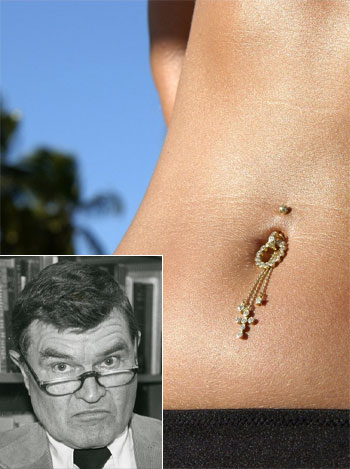
Q: This week I realized I still have the piercings I got in high school, but I'm in university now. As an 18 year old hoping to be a little classier than she started out as once I'm done with my schooling, what are your stances on piercings? I have my ears pierced twice over, as well as a simple cartilage piercing. I usually wear small sliver sleepers. I also have my naval pierced (despite knowing it's trashy) and am justifying it because only my boyfriend has seen it. I haven't changed it either, since anything that dangles or had rhinestones was just too gaudy even for my younger self. Should I take any of these out? What should I wear if I keep them in? Thank you! — Tessa
A: Our favorite Ask the MB submissions are the ones where readers answer their own question. It's a real timesaver!
Trust that your forthcoming jewelry and infection-reduction strategy is firmly grounded in the core principle of understatement, and would be zealously endorsed by MB patriarch Paul Fussell (RIP), who wrote in Class, "Both men's and women's elite looks are achieved by a process of rejection — of the current, the showy, the superfluous." He's talking about cartilage piercings here, Tessa.
Best of luck in college, and may any naval scarring be at a minimum.
Q: Page 60 of Paul Fussell's book Class, last paragraph 3rd line down states "the two-button suit is more prole than the three-button Eastern-establishment model."
Just wondering if I shouldn't listen to this part of the Bible due to your stance on the three-button suits, at least for the average size man. And keep wearing the two-button.
P.S. Rest in Peace Fussell. He was a God among not just men, but gentlemen. —Jack
A: Last week, researchers in Tel Aviv determined that camels didn't exist in Israel until centuries after Abraham, Jacob, and Joseph lived — yet the Bible mentions camels more than 20 times.
The Bible Bible, that is. Not Class. But sometimes Fussell can be fallible too. Two-button suits elongate the torso, and elongated torsos have long been the grail of the American overclass. Which is why yoga studios per capita tracks so precisely with income per capita in the U.S. (We are totally making this up but are certain it is true.)
An elongated torso helps accentuate the natural V of a man's body, and as Tom Ford has suggested in the past, emphasizing that natural V is the key to a magnificent presence.
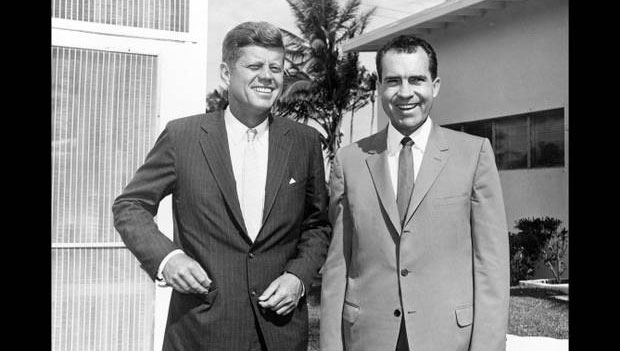
To see this principle in action, consider the classic portrait of John F. Kennedy and Richard Nixon above. JFK looks vital and commanding, the King of Camelot. Nixon looks stout, shifty, Nixonian.
So while our admiration for Fussell remains as strong as ever, our thoughts on two-button versus three-button are as fixed as the word of God on a stone tablet. Leave the three-buttons to Mahmoud Ahmadinejad, Todd Palin, and Tricky Dick.
Dozens of readers have written in to ask what constitutes an MB car. We haven't answered any of them.
Here's Fussell's take.
The automobile, like the all-important domestic façade, is another mechanism for outdoor class display. Or class lack of display we'd have to say, if we focus on the usages of the upper class, who, on the principle of archaism, affect to regard the automobile as very nouveau and underplay it consistently. Class understatement describes the technique: if your money and freedom and carelessness of censure allow you to buy any kind of car, you provide yourself with the meanest and most common to indicate that you're not taking seriously so easily purchasable and thus vulgar a class totem. You have a Chevy, Ford, Plymouth, or Dodge, and in the least interesting style and color. It may be clean, although slightly dirty is best. But it should be boring. The next best thing is to have a "good" car, like a Jaguar or BMW, but to be sure it's old and beat-up. You may not have a Rolls, a Cadillac, or a Mercedes. Especially a Mercedes, a car, Joseph Epstein reports in The American Scholar (Winter 1981-82), which the intelligent young in West Germany regard, quite correctly, as "a sign of vulgarity, a car of the kind owned by Beverly Hills dentists or African cabinet ministers."
...the ultimate class bifurcation based on drink is simpler than [what they're served in], and it cuts straight across the center of society, unmistakably dividing the top classes from the bottom. I'm speaking about the difference between dry and sweet. If the locution of "a Seven and Seven" is strange to you, if your nose wrinkles a bit at the idea of drinking a shot of Seagram's Seven Crown mixed with Seven-Up, you are safely at or near the top, or at least not deeply compromised by the sugar fixation at the bottom. Bourbon "and ginger" is another drink favored down there but virtually unknown higher up. Both these, like daiquiris and stinger mists, brandy Alexanders and sweet manhattans, are often consumed before dinner, suggesting that the apéritif principle is not well understood except by non-proles who have undertaken extensive, i.e., European, travels.
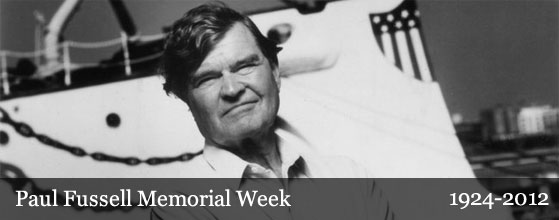
It's been a week since Paul Fussell died and we've mourned the best way we know how: by re-reading Class for what we believe is either the 30th or 31st time since its publication in 1983 (we read it at least once a year). No, obitwriters, Fussell's masterpiece is not The Great War and Modern Memory, which won the National Book Award in 1976 and we're convinced is a very good book; it's Class, his sagacious, hilarious examination of social class in America.
We think so highly of this book that we've made it required reading for family, any prospective SO, even for prospective acquaintances with whom interactions have gone beyond "hi." If you receive this book as a gift from us — and we gift it often — consider it an invitation to a club where "What would Fussell say?" is the secret handshake.
For the rest of the week we're pulling our favorite bits from Class because, well, it helps us deal with this loss.
Fussell on elite male and female looks in the U.S.:
It requires women to be thin, with a hairstyle dating back eighteen or twenty years or so. (The classiest women wear their hair for a lifetime in exactly the style they affected in college.) They wear superbly fitting dresses and expensive but always understated shoes and handbags, with very little jewelry. They wear scarves—these instantly betoken class, because they are useless except as a caste mark. Men should be thin. No jewelry at all. No cigarette case. Moderate-length hair, never dyed or tinted, which is a middle-class or high-prole sign, as the practice of President Reagan indicates. Never a hairpiece, a prole usage. (High and mid-proles call them rugs, mats, or doilies. Calling them toops is low-prole. Both women's and men's elite looks are achieved by a process of rejection—of the current, the showy, the superfluous. Thus the rejection of fat by the elite.
POURCAST
BETA
Vieux Carré
1 oz rye whiskey
1 oz cognac
1 oz sweet vermouth
1/4 oz Benedictine liqueur
2 dashes Peychaud's bitters
2 dashes Angostura bitters
Build all ingredients in an ice-filled rocks glass. Stir. Garnish with a maraschino cherry.